


Customers do not think in terms of separate online and physical channels. They may discover a product on Google, look at it on the site, try it in the store, buy it from the phone and return it in another store.
For the company, however, these steps are still often measured by different teams, platforms and budgets. Hence, a distortion arises:a single customer journey is read as a series of independentfunnels.
The result is that attribution, CAC and customer value can be misinterpreted.
What Makes a Customer Journey Truly Omnichannel
Being present on many channels is not enough. The omnichannel operations exists when the customer can switch from one touchpoint to the other while maintaining continuity of information, availability and service.
- display store availability;
- order online and physically withdraw;
- be assisted in store and receive the product from another node;
- make a cross-channel return;
- be recognized in CRM and the loyalty;
- receive communications consistent with what you have already done in other touchpoints.
The goal is not to multiply services. It is to reduce friction when the customer wants to move forward in the journey.
How Omnichannel Journeys Can Increase Conversion
Each operating constraint removed increases the number of paths available to complete the purchase.
If a size is missing in the store, the Buy On Behalf can recover the sale using stock elsewhere. If the customer does not want to wait for a delivery at home, the Click and Collect can offer an alternative. If they fear a complex return, the possibility of returning to the store can reduce the perceived risk.
It does not mean that each omnichannel function automatically increases conversion. It means that the project should be evaluated in terms offriction removedand observed impact on actual behavior.
Blended CAC: When Last Click Tells Only Part of the Story
A user can be acquired from a digital campaign and buy in store. They may also receive advice in a store and complete the online transaction a few days later.
Assigning all value to the touchpoint that closes the purchase risks rewarding or penalizing the wrong channel. For this reason in omnichannel retail it is useful to add to the channel metrics a reading of theblended CAC: how much does it cost to acquire a new customer considering the ecosystem as a whole?
It does not eliminate the problem of attribution, but it shifts the question from ‘Who gets credit?’ to ‘What does it actually cost us to acquire a new customer?’
Customer Lifetime Value: the real horizon is the next purchase
The conversion of the session is important, but it is only a snapshot. A mature omnichannel model also looks at the likelihood of the customer coming back.
Multiple options of purchase, pickup, service and return can make the relationship easier. If this simplicity increases purchase frequency, retention or average value over time, the effect is reflected in Customer Lifetime Value.
For this reason, LTV and CAC should be read together: acquiring a customer at a higher cost can make perfect sense if that segment generates a significantly higher value over time.
The physical store changes role
In an omnichannel model the store is not the competitor of the site. It can be at the same time a point of relationship, sale, pickup, return and in some cases, a fulfillment node.
The limit is often not technological but organizational. If stores and eCommerce have goals that compete with each other, each cross-channel service becomes difficult to scale.
Internal allocation rules, incentives and KPIs are therefore needed to recognize the contribution of different touchpoints to the same relationship with the customer.
KPIs I Would Track
- conversion rate of the omnichannel journeys compared to single-channels;
- share of customers identified on multiple touchpoints;
- use and conversion of Click and Collect and Buy On Behalf;
- CAC channel and blended CAC;
- repurchase frequency and retention;
- Customer Lifetime Value per segment;
- rate and cost of return by mode;
- sales recovered thanks to extensive stock availability.
Technology doesn’t solve a badly designed funnel
CRM, OMS, CDP, loyalty platform and analytics are tools. First we need to define the experiences we want to offer, the necessary data, process ownership and the way we measure the effect.
Only then can technology make the model scalable.
In summary
The omnichannel customer journey has value when it makes it easier to buy and continue the relationship with the brand. It is this continuity that can be reflected on conversion rate, blended CAC and Customer Lifetime Value.
The decisive step is to stop optimizing individual channels and start measuring the customer as one unified relationship.
Related advisory:For the operating model, business requirements and KPI framework behind these capabilities, see myomnichannel and Order Management consultingapproach.
Need to unblock an eCommerce or marketing project?
Tell me what you want to achieve and where the project is getting stuck.
Related articles
OMS vs ERP vs WMS: What Each System Owns and What an eCommerce Business Actually Needs
A practical guide to separating enterprise, warehouse and order-management responsibilities in omnichannel architecture.
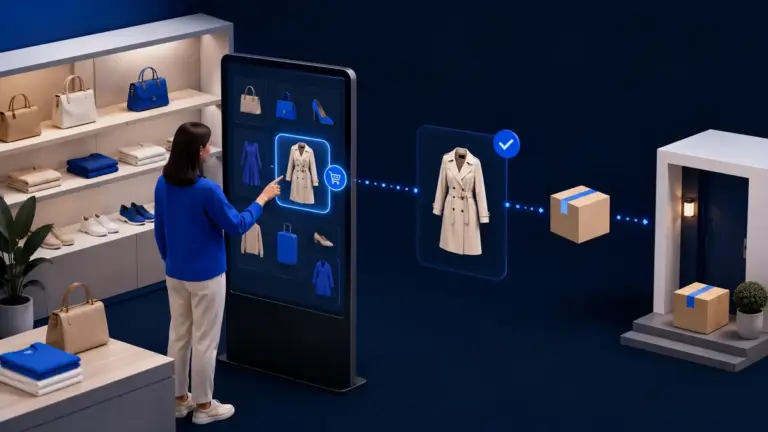
Endless Aisle: Recover In-Store Sales Beyond Shelf Availability
Endless Aisle: how to recover lost sales for unavailable and measure conversion, adoption, margin and savings on stock.
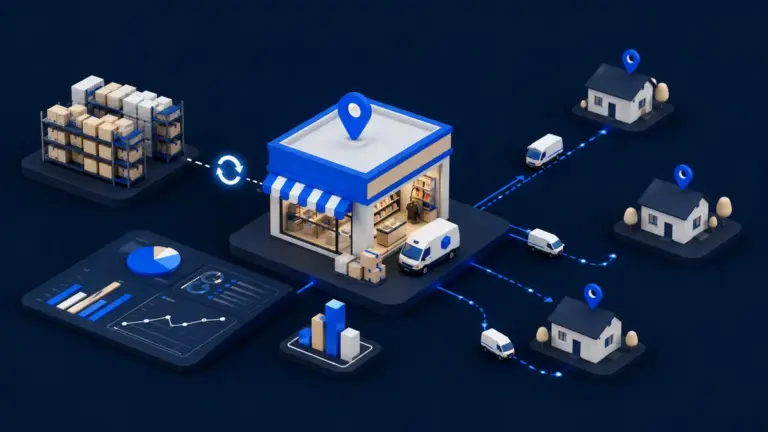
Ship-from-Store: Turn Retail Locations into Efficient Fulfillment Nodes
How to design the Ship-from-Store with orchestration rules, KPI logistics and complete cost calculation per order.