


A language model knows what it has learned during training, but does not automatically have procedures, lists, contracts or updated company manuals.Enterprise RAG—Retrieval-Augmented Generation—addresses this limit by recovering the relevant information from a document repository before generating the answer.
The difference is important: the model is not asked to remember all internal information. It is provided, for each question, with the most relevant passages and their sources. The final quality therefore depends on two distinct systems: the one that finds the information and the one that turns it into an answer.
How a RAG pipeline works
The documents are acquired, cleaned and divided into usable portions. Each portion receives metadata such as source, date, department, product and access level. When a question arrives, the system identifies the most relevant passages, can reorder them by relevance and inserts them into the context given to the model.
| Phase | Activities | Frequent error |
|---|---|---|
| Injection | Collects and converts sources | Import obsolete or duplicate versions |
| Subdivision | Create consistent portions of text | Breaking definitions and tables out of context |
| Indexing | Makes content searchable | Poor or inconsistent metadata |
| Retrieval | Select the relevant steps | Recovering similar but not applicable content |
| Generation | Produce the answer using sources | Integrate unsupported claims |
| Verificationtion | Check response and references | Evaluate text style only |
RAG, traditional search or fine-tuning?
Traditional search is suitable when the user wants to find the document and read it. RAG is useful when a user needs to get a summary or a response built using multiple sources. Fine-tuning, on the other hand, changes the model’s behavior and is better suited to style, format or recurring tasks; it is not the easiest way to keep up-to-date information that often changes.
The three approaches can coexist. An internal assistant can offer the link to the document, generate a response with quotes and follow a learned format. The criterion is not to choose the most sophisticated technology, but to associate each problem with the correct mechanism.
Use Cases with Clear Business Value
In customer support, the RAG can retrieve commercial terms and procedures related to the product concerned. In sales it can compare technical data sheets, materials and document availability. For employees it can transform manuals, policies and knowledge bases into a conversational access point.
The scope must remain explicit. An answer on an operating procedure requires approved sources; a legal or financial question may require the system to surface the source document and pass the decision on to a person. RAG improves access to knowledge, but does not automatically assign authority to any file in the archive.
Access and governance cannot be added after
The system must respect the same permissions as the original sources. If an employee cannot open a contract, they should not receive the content through the assistant. The authorization metadata must therefore accompany the documents during indexing and retrieval, not be filtered only in the final interface.
We also need an owner for each source, a date of validity, update rules and version management. When two documents contradict each other, the model cannot decide which one represents the company policy without a predefined governance rule.
How to Measure Enterprise RAG
| KPI | Question | Reading method |
|---|---|---|
| Retrieval hit rate | Is the correct source recovered? | Test on questions with a known answer |
| Groundedness | Are the statements supported by the passages? | Automatic evaluation and human sample |
| Completeness of quotations | Do the sources cover the decisive points? | Share of verifiable claims related to a source |
| Acceleration rate | Is the answer used without correction? | Feedback and user behavior |
| Time to the useful response | How fast is the job? | Comparison with manual search |
| Cost per response resolved | How much is the correct result? | Indexing, models, revision and infrastructure |
Why RAG can fail even with a good model
A poorly scanned document, a lost table during conversion or a contextless question may compromise retrieval. Even the choice of chunks that are too large dilutes relevance, while chunks that are too small eliminate the information needed to interpret the text.
RAG does not eliminate hallucinations: it makes them more controllable only if the system requires the model to stay grounded in its sources and can declare when it does not find sufficient evidence. To start it is better to select a limited corpus, build a set of real questions and measure retrieval and generation separately. A reliable RAG base can then also support anagentic AI, maintaining knowledge and action on two verifiable levels.
Related advisory:If this topic is part of a broader growth or transformation program, see mydigital strategy consultingapproach.
Need to unblock an eCommerce or marketing project?
Tell me what you want to achieve and where the project is getting stuck.
Related articles

Digital Twins: Simulate Processes and Operations Before You Invest
Digital twin: differences compared to models and dashboards, applications, data needed, KPI and method to build a sustainable project.
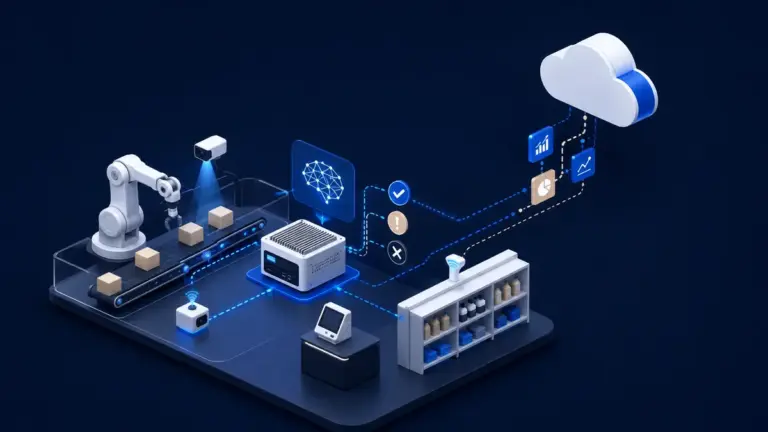
Edge AI: Bringing Intelligence Closer to the Data
Edge AI: differences from the cloud, applications, hybrid architecture and KPI to measure latency, quality, continuity and cost.

Agentic AI in Business: From Chatbots to Autonomous Workflows
How to design AI agent in the company: autonomy levels, applications, permissions, human control and KPI to measure results.